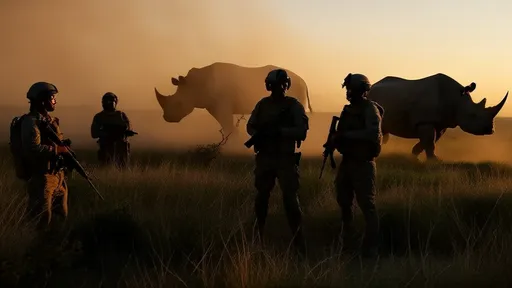
In the vast, sun-scorched landscapes of Africa, a brutal and relentless war is being waged. It is not a conflict between nations or ideologies, but a desperate fight for survival. On one side are the poachers, armed with high-caliber rifles, night-vision goggles, and a ruthless determination fueled by the immense profits of the illegal wildlife trade. On the other are the guardians, a dedicated and increasingly militarized force of rangers who stand as the last line of defense for one of the continent's most iconic and endangered creatures: the rhinoceros.
The stakes could not be higher. A rhino's horn is not made of bone, but of keratin, the same substance as human fingernails. Yet, on the black markets of Asia, particularly in Vietnam and China, it is falsely revered as a status symbol, a cure for cancer, and a powerful aphrodisiac. Gram for gram, it can fetch a higher price than gold or cocaine, creating a financial incentive so powerful that it has pushed both the black and white rhino to the brink of extinction. This economic driver has transformed poaching from a subsistence activity into a highly organized, sophisticated, and violent criminal enterprise, often linked to international syndicates and even terrorist groups seeking funding.
In response, the strategy for protecting these majestic animals has undergone a dramatic evolution. The days of the unarmed, lone ranger patrolling on foot are largely over. Today's anti-poaching units resemble special forces more than traditional park wardens. They are equipped with military-grade hardware: automatic rifles, satellite phones, drone surveillance systems, and sophisticated tracking equipment. They undergo intense tactical training, learning advanced combat techniques, night operations, and intelligence gathering. Their mission is no longer simply to observe and report; it is to actively seek out, intercept, and neutralize poaching threats before they can claim another life.
These rangers operate in a state of perpetual hyper-vigilance. Patrols can last for weeks, covering treacherous terrain under a blistering sun or in the pitch black of night. Every rustle in the bush, every set of unfamiliar tracks, could signal an imminent threat. The tension is palpable, a constant companion that wears on the mind and body. They are not just fighting poachers; they are battling exhaustion, the elements, and the psychological toll of knowing that a single mistake, a moment of missed intel, could result in the death of an animal they are sworn to protect and potentially their own.
The human cost of this war is profound. Rangers face incredible danger. Dozens are killed in the line of duty each year, outgunned in sudden, violent ambushes. They leave behind families who live with the constant fear that their loved one may not return from their next patrol. The trauma of these engagements, of losing colleagues and witnessing the gruesome aftermath of a poached rhino—its face hacked off while it was likely still alive—leaves deep psychological scars. Yet, their resolve remains unbroken, driven by a deep-seated belief in their cause and a connection to the wildlife they protect.
On the other side of the conflict, the poachers are often not mustache-twirling villains but individuals ensnared by complex socio-economic realities. Many come from impoverished communities bordering national parks and reserves. With few legitimate economic opportunities, the promise of a life-changing sum of money for a single horn is an irresistible lure. They are the foot soldiers, the expendable pawns in a much larger game directed by shadowy figures who rarely set foot on the soil of Africa. This creates a tragic irony: the very communities that live alongside these incredible animals often see little benefit from their conservation and are recruited to participate in their destruction.
The battle is not fought with bullets alone. Technology has become a crucial force multiplier for conservation efforts. Motion-sensitive camera traps hidden throughout reserves provide real-time alerts to ranger stations. Thermal imaging drones silently scan vast areas from the sky, spotting human heat signatures long before poachers can reach their targets. Some conservation groups are even experimenting with embedding microchips and GPS trackers into rhino horns and even de-horning rhinos entirely to make them worthless to poachers. DNA analysis of confiscated horns is being used to create a database to trace seized products back to their source, helping to dismantle the trafficking networks.
Despite these heroic efforts, the challenges are immense and multifaceted. Corruption remains a cancer that undermines progress at every level. From low-level officials accepting bribes to look the other way, to high-ranking individuals allegedly facilitating the trade, it erodes the foundation of law enforcement. The vastness of the terrain is another formidable opponent. National parks like Kruger in South Africa are the size of small countries, making it impossible to monitor every inch simultaneously. Poachers, with their intimate knowledge of the land, exploit these gaps in security with deadly efficiency.
Ultimately, the armed defense of rhinos is a critical, but reactive, measure. It addresses the symptom—the killing—but not the root cause: the demand. The long-term survival of the species hinges on a multi-pronged strategy that extends far beyond the battlefield. Intensifying education campaigns in consumer countries to shatter the myths surrounding rhino horn's medicinal properties is essential. Developing alternative livelihoods for communities living near wildlife areas is crucial to turning them from potential adversaries into allies in conservation. Strengthening international legal frameworks and cross-border cooperation is needed to choke the trafficking routes and bring the kingpins of this illicit trade to justice.
The rangers in the bush are buying time, precious time, with their courage and commitment. They stand between the rhino and the void, their rifles a stark symbol of a world where the protection of nature has become a combat mission. Their fight is a testament to human dedication in the face of greed and violence. Whether this war is won will depend not only on their bravery but on a global collective will to value a living rhino on the African plains infinitely more than a carved ornament on a shelf or a ground powder in a misguided tonic. The future of an entire species hangs in the balance.

By /Aug 25, 2025

By /Aug 25, 2025
By /Aug 25, 2025

By /Aug 25, 2025

By /Aug 25, 2025

By /Aug 25, 2025
By /Aug 25, 2025

By /Aug 25, 2025

By /Aug 25, 2025

By /Aug 25, 2025

By /Aug 25, 2025
By /Aug 25, 2025

By /Aug 25, 2025
By /Aug 25, 2025
By /Aug 25, 2025

By /Aug 25, 2025
By /Aug 25, 2025
By /Aug 25, 2025

By /Aug 25, 2025

By /Aug 25, 2025