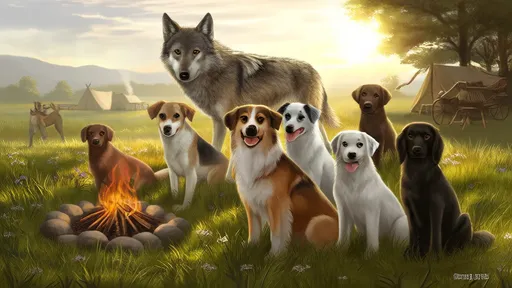
The journey of the domestic dog from its wild wolf ancestors is one of the most fascinating narratives in the history of animal domestication. This transformation, spanning tens of thousands of years, was not a deliberate human endeavor but rather a complex interplay of mutual benefit, genetic adaptation, and co-evolution. The story is written not only in archaeological remains but deeply embedded in the very DNA of modern dogs, revealing a shared past that continues to shape our present relationship with humanity's oldest friend.
The prevailing scientific consensus suggests that the process began during the late Pleistocene era, somewhere between 20,000 and 40,000 years ago. As humans transitioned from nomadic hunter-gatherers to more settled groups, our waste dumps became a consistent and valuable food source for local wildlife. The wolves that were bold enough to scavenge near human camps, yet timid enough to avoid conflict, found a new ecological niche. These protodogs were not yet pets; they were commensal scavengers, living near humans and benefiting from our leftovers without providing any service in return. This self-domestication hypothesis posits that the initial steps away from wolfhood were taken by the wolves themselves, driven by natural selection favoring those with reduced fear and aggression towards humans.
Over generations, this proximity forged a new relationship. Humans likely began to see value in these tolerant canines. Their keen senses of smell and hearing made them excellent early warning systems for approaching predators or rival human groups. Their inherent pack structure meant they could understand social cues and integrate into a human-led hierarchy. This shift from passive scavenging to active cooperation marked the true beginning of the domestication pathway. Early humans probably began encouraging the tamest individuals to stay, inadvertently applying a form of unconscious selective pressure. The friendliest wolves, those with pedomorphic, or juvenile, traits like floppy ears, shorter snouts, and less aggressive tendencies, were more tolerated and thus had greater opportunities to reproduce. This selection for tameness is now understood to be the cornerstone of the entire domestication syndrome, a suite of physical and behavioral changes common to many domesticated species.
The genetic evidence for this evolution is profound and has been dramatically illuminated by modern genomics. By comparing the genomes of modern dogs from around the world with those of ancient dog fossils and modern gray wolves, scientists have painted a detailed picture of their divergence. Key genetic changes are linked to the domestication process. For instance, mutations in genes like WBSCR17 and GTF2I are associated with hypersocial behavior and reduced fear, traits that would have been essential for a wolf to comfortably live near humans. Other genes show strong selection for starch digestion. The AMY2B gene, which produces amylase, an enzyme critical for breaking down starch, has many more copies in dog genomes than in wolf genomes. This adaptation allowed early dogs to thrive on a diet rich in agricultural grains and human food scraps, a diet that would be maladaptive for a pure carnivore like a wolf. This genetic adaptation mirrors our own history with agriculture and solidifies the idea that dogs co-evolved with us, their biology changing in response to changes in human society.
The physical and archaeological record, though fragmentary, provides crucial corroboration. The oldest widely accepted dog remains, found in Bonn-Oberkassel, Germany, date back approximately 14,200 years. This animal was not merely a tamed wolf; its morphology—a shorter snout and wider braincase—distinguished it from its wild cousins. Significantly, it was found buried alongside two humans, evidence of a bond that transcended utility and entered the realm of companionship and perhaps even spiritual significance. Earlier potential dog remains, such as the 36,000-year-old Goyet Cave specimen in Belgium, remain subjects of intense debate, highlighting the challenge of pinpointing the exact moment a wolf became a dog. What is clear is that by the time of widespread human agricultural settlements, distinct dog forms were present across Eurasia.
This domestication process was not a single, linear event but likely occurred in multiple waves and different locations. Genetic studies suggest an initial divergence from wolves in Eurasia, followed by a complex history of migration, isolation, and interbreeding with local wolf populations as humans spread across the globe. Dogs accompanied humans on every major migration, serving as hunters, guardians, and companions. This shared journey led to an incredible diversification of form and function long before the era of formal breed creation. From the massive, cold-adapted dogs of the Arctic that helped pull sleds to the small, agile dogs that aided in hunting across Asia, regional types emerged through both natural and human-driven selection for specific tasks.
The profound behavioral shift from wolf to dog is perhaps the most remarkable aspect of their evolution. Wolves are capable of forming strong social bonds, but their world view is fundamentally different. Dogs have developed a unique ability to read human social and communicative cues. They can follow a human's pointed finger or gaze to find hidden food, a skill that even chimpanzees, our closest genetic relatives, struggle with. This innate understanding of human intention is not something they learn through intensive training; puppies as young as eight weeks old show this ability. This suggests that selection for communication with humans is deeply embedded in their genetics. They have evolved to be keen observers of human behavior, making them unparalleled partners in work and companions in life.
In conclusion, the evolution of the dog was a grand, millennia-long experiment in co-evolution. It was not engineered by ancient geneticists but emerged from a mutually beneficial relationship between two species. Genetic mutations for tameness and starch digestion provided the biological foundation, while human society provided the ecological niche. From wary scavengers at the edge of the firelight to beloved members of the family, dogs have walked a unique path alongside us. Their story is inextricably woven into our own, a testament to the power of an unlikely partnership that forever changed the trajectory of both species. The wolf may still echo in the dog's howl, but its heart belongs unequivocally to humanity.

By /Aug 25, 2025

By /Aug 25, 2025
By /Aug 25, 2025
By /Aug 25, 2025

By /Aug 25, 2025

By /Aug 25, 2025
By /Aug 25, 2025

By /Aug 25, 2025
By /Aug 25, 2025
By /Aug 25, 2025

By /Aug 25, 2025
By /Aug 25, 2025
By /Aug 25, 2025
By /Aug 25, 2025
By /Aug 25, 2025
By /Aug 25, 2025
By /Aug 25, 2025
By /Aug 25, 2025
By /Aug 25, 2025
By /Aug 25, 2025
