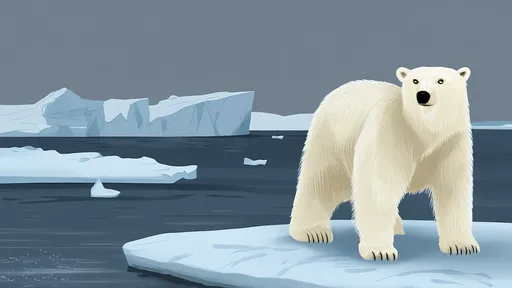
The Arctic is unraveling before our eyes, and at the heart of this disintegration is a story of profound loss, embodied by its most iconic inhabitant: the polar bear. For centuries, these majestic predators have ruled the frozen seas, supremely adapted to a life of hunting seals from the platform of sea ice. But the foundation of their world is literally melting beneath their feet. The intricate and brutal logic of the Arctic food web is being undone, leading polar bears down a path of starvation—a direct and harrowing consequence of the climate crisis.
The entire existence of a polar bear is a masterclass in energy efficiency, honed by millennia of evolution. Their survival is a high-stakes equation centered on the accumulation and conservation of fat. During the late spring and early summer, when seal pups are abundant and vulnerable, polar bears engage in a frantic feast. They consume massive amounts of blubber, building up the fat reserves that must sustain them through the leaner months when hunting is poor or the ice retreats. This seasonal rhythm, dictated by the freeze and thaw of the sea, is the metronome to which their lives are set. Disrupt this rhythm, and the entire symphony falls into chaos.
The primary disruption is the rapid and unprecedented loss of sea ice. The Arctic is warming at more than twice the global average rate, causing the ice to form later in the autumn, break up earlier in the spring, and thin dramatically. This ice is not merely frozen water; it is the polar bear’s hunting ground, its highway, and its resting place. It is the stage upon which the critical predator-prey relationship between bear and seal plays out. Without it, the bears are stranded, and their primary hunting strategy—still-hunting at seal breathing holes or breaking into pupping dens—becomes impossible.
The chain reaction of this loss is both immediate and devastating. As the ice platform shrinks and retreats further from shore, bears are forced to expend a catastrophic amount of energy simply to reach viable hunting grounds. Long, desperate swims in open water, which are becoming increasingly common, drain their precious fat reserves without the guarantee of a meal at the journey's end. Researchers have documented bears swimming for over a hundred miles, a feat that leaves them emaciated and weakened even if they survive. Others drown from exhaustion in stormy seas they were never evolutionarily prepared to navigate.
For those bears that stay on land, the situation is equally dire. The extended ice-free season means a prolonged fast, often lasting months longer than their physiology is designed to handle. They are left to wander coastlines and human settlements, scavenging for bird eggs, berries, or garbage—low-energy substitutes that are woefully inadequate to maintain their immense body mass. The sight of a gaunt, skinny polar bear, a skeleton draped in white fur, is becoming a more common and heartbreaking symbol of the new Arctic reality. Their muscles atrophy, their bodies begin to consume their own organs for protein, and they slowly, painfully starve.
The crisis extends beyond the individual bear to threaten the entire population. Starving females cannot produce sufficient milk for their cubs, leading to higher cub mortality rates. Those cubs that do survive are often underweight and less likely to make it to adulthood. The reproductive rate of the species is plummeting, as malnourished bears delay breeding or fail to reproduce altogether. The very future of the species is being compromised, not by a singular event, but by a slow, grinding process of energetic deficit.
This story of the polar bear’s starvation is the most visible symptom of a much larger ecosystem collapse. The sea ice is the engine of the Arctic marine environment. Its underside is coated with algae, the base of a food web that supports everything from tiny crustaceans to Arctic cod to the seals that are the polar bear’s main prey. As the ice disappears, this productivity plummets, reducing the health and abundance of the seals themselves. Even if a bear finds a patch of ice, the seals there may be scarcer and leaner, providing a less nutritious meal. The problem is compounding from the bottom up and the top down simultaneously.
The fate of the polar bear is no longer a speculative forecast for the future; it is a documented reality of the present. Scientific studies, combining satellite imagery of ice loss with on-the-ground monitoring of bear health, draw a direct and unequivocal line between rising global temperatures, sea ice decline, and increased bear starvation and population decline. They are a living barometer for the health of our planet, and the reading is catastrophic.
Their struggle is a stark and powerful indictment of human-caused climate change. It is a reminder that the consequences of a warming world are not abstract concepts or distant statistics; they are visceral, suffering, and unfolding in real-time in the high Arctic. The image of a starving polar bear, once a symbol of formidable strength, is now a gut-wrenching preview of a world we are creating—a world where the rhythms of nature are broken, and the most specialized and magnificent creatures are the first to falter. Their hunger is the Arctic’s hunger, and it echoes as a warning we can no longer afford to ignore.

By /Aug 25, 2025
By /Aug 25, 2025
By /Aug 25, 2025
By /Aug 25, 2025

By /Aug 25, 2025

By /Aug 25, 2025
By /Aug 25, 2025

By /Aug 25, 2025
By /Aug 25, 2025
By /Aug 25, 2025

By /Aug 25, 2025
By /Aug 25, 2025
By /Aug 25, 2025
By /Aug 25, 2025
By /Aug 25, 2025
By /Aug 25, 2025
By /Aug 25, 2025
By /Aug 25, 2025
By /Aug 25, 2025
By /Aug 25, 2025
