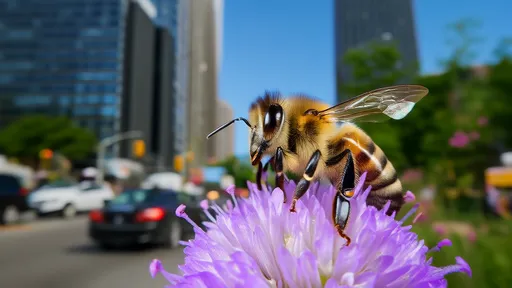
In the heart of our bustling cities, a quiet but vital transformation is unfolding. Amidst the concrete and glass, an unexpected ally has emerged: the urban bee. Once symbols of pastoral countryside life, bees and other pollinators are increasingly adapting to metropolitan environments, revealing a complex narrative of resilience, challenge, and coexistence. As green roofs, community gardens, and parklands dot the urban landscape, these insects are not merely surviving—they are forging new ecological roles, prompting scientists and citizens alike to reconsider what it means to be a city dweller.
The relationship between urbanization and pollinator health is far from straightforward. On one hand, cities pose significant threats: habitat fragmentation, pollution, and the notorious urban heat island effect create hostile conditions for many species. Pesticides used in ornamental landscaping, light pollution disrupting nocturnal pollinators, and the scarcity of diverse floral resources further exacerbate their plight. Studies have shown that some native bee populations decline sharply in highly urbanized areas, struggling to find nesting sites or sufficient food. For pollinators already facing global declines due to agricultural intensification and climate change, cities can represent another frontier of adversity.
Yet, paradoxically, urban areas are also becoming unintended sanctuaries. Research from cities like London, Berlin, and New York has documented surprising biodiversity among pollinator communities. Green initiatives—such as converting vacant lots into wildflower meadows, installing bee hotels, and promoting pollinator-friendly gardening—have turned pockets of the city into havens. Unlike monoculture farmlands, urban gardens often feature a high diversity of plants, providing nectar and pollen throughout longer seasons. This floral abundance can support robust populations of bees, butterflies, and even hoverflies, which in turn enhance the pollination of urban agriculture and native plants.
The adaptability of pollinators themselves is a key factor in this urban success story. Generalist species, such as the common carder bee or the red-tailed bumblebee, thrive in cities by utilizing a wide variety of flowers and nesting in unconventional sites like cracks in walls or abandoned machinery. Honeybees, managed by urban beekeepers, have become iconic residents of rooftops and balconies. Meanwhile, some solitary bees exhibit remarkable behavioral plasticity, adjusting their foraging patterns to avoid peak human activity or exploiting new resources offered by exotic plants. This flexibility underscores their evolutionary resilience but also highlights a filtering effect: specialists with narrow habitat requirements often vanish, leaving behind a homogenized but persistent community.
Urban planning and policy play crucial roles in shaping these dynamics. Cities that prioritize green infrastructure—such as interconnected parks, green corridors, and regulations limiting pesticide use—see measurable benefits for pollinator conservation. For instance, the Bees’ Needs initiative in the UK engages communities in creating foraging habitats, while cities like Oslo have implemented bee highways—networks of pollinator-friendly spaces that allow insects to navigate safely. Such efforts not only support biodiversity but also enhance ecosystem services: urban pollinators contribute to food security by boosting yields in community gardens and rooftop farms, and they enrich the cultural and educational fabric of city life.
However, the picture is not entirely rosy. The proliferation of honeybees in cities, often driven by well-intentioned beekeeping campaigns, can sometimes harm wild pollinators by intensifying competition for resources. Diseases spread from managed hives to wild populations pose additional risks. Moreover, socioeconomic disparities mean that greener, pollinator-rich neighborhoods are often affluent, raising questions about environmental justice and equitable access to nature’s benefits. Addressing these challenges requires nuanced strategies that balance enthusiasm for conservation with ecological realism and inclusivity.
Public engagement has emerged as a powerful force in this urban pollinator movement. Citizen science projects, such as Bumblebee Watch or iNaturalist, enable residents to document and learn about local species, fostering a sense of stewardship. Schools, businesses, and community groups are planting native flowers, reducing lawn areas, and advocating for pollinator-friendly policies. This grassroots activism not only amplifies conservation impact but also reconnects urbanites with the natural world, cultivating a culture of care that transcends traditional boundaries between human and insect, built and wild.
Looking ahead, the fate of urban pollinators will be intertwined with broader trends in sustainable development. As cities grow—projected to house over two-thirds of humanity by 2050—their design and management will determine whether they become ecological traps or refuges. Integrating pollinator needs into urban planning, from transportation networks to housing projects, offers a path toward resilient, multifunctional landscapes. Innovations like pollinator-specific green roofs, AI-assisted monitoring, and climate-adaptive planting schemes hold promise for fostering coexistence.
Ultimately, the story of bees in the city is a microcosm of humanity’s relationship with nature in the Anthropocene. It reveals our capacity to both harm and heal, to displace species and to make room for them. By championing urban pollinators, we do more than safeguard biodiversity; we reimagine the city as a living system, where every window box, sidewalk strip, and railway verge can contribute to a thriving ecological tapestry. In the hum of a bee hovering over a rooftop garden lies a reminder: even in the most built environments, nature persists, adapts, and inspires—if we choose to let it.
By /Aug 25, 2025

By /Aug 25, 2025
By /Aug 25, 2025
By /Aug 25, 2025

By /Aug 25, 2025

By /Aug 25, 2025
By /Aug 25, 2025

By /Aug 25, 2025
By /Aug 25, 2025
By /Aug 25, 2025
By /Aug 25, 2025
By /Aug 25, 2025
By /Aug 25, 2025
By /Aug 25, 2025
By /Aug 25, 2025
By /Aug 25, 2025
By /Aug 25, 2025
By /Aug 25, 2025
By /Aug 25, 2025
By /Aug 25, 2025