The animal rights movement represents one of the most profound ethical awakenings of our time, evolving from a fringe philosophical position into a global force reshaping diets, industries, and laws. What began as a call for individual dietary change has matured into a complex, multi-faceted campaign seeking nothing less than a fundamental reordering of humanity's relationship with other sentient beings.
At its heart, the movement is built on a simple but revolutionary premise: that animals are not mere property or resources for human use, but beings with intrinsic value and interests deserving of moral consideration. This core idea challenges centuries of anthropocentric tradition, arguing that the capacity to suffer, rather than the capacity to reason, grants a being the right to ethical treatment. This philosophical shift has fueled every aspect of the movement's growth, from dinner tables to courtrooms.
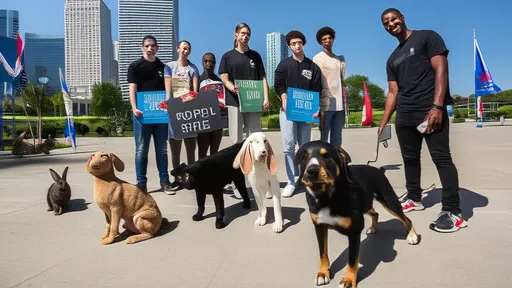
The most visible manifestation of animal rights advocacy has been the dramatic rise of vegetarianism and veganism. Once considered an eccentric dietary choice, plant-based living has entered the mainstream, propelled by growing awareness of factory farming's horrors. Undercover investigations have revealed the grim reality of industrial agriculture: animals confined in spaces so small they cannot turn around, subjected to mutilations without pain relief, and living in conditions that would be illegal if applied to dogs or cats. These revelations have driven millions to remove animal products from their plates, not just for health or environmental reasons, but as a moral stance against systemic cruelty.
Beyond individual dietary choices, the movement has targeted the economic structures perpetuating animal exploitation. Boycotts, shareholder activism, and corporate campaigns have pressured major food companies to adopt more humane policies. Restaurant chains and grocery stores have increasingly responded to consumer demand for cage-free eggs, crate-free pork, and plant-based alternatives that now sit alongside traditional meat products. The market has spoken: ethics can be good business.
Perhaps the most significant evolution has been the movement's strategic turn toward legal and political action. Recognizing the limitations of consumer choice alone, advocates have pursued legislative changes that institutionalize animal protections. These efforts have achieved remarkable successes across multiple fronts. Dozens of countries have banned cosmetic testing on animals. The European Union has implemented some of the world's strongest farm animal welfare standards. Several nations have recognized animal sentience in their legal codes, creating a foundation for more robust protections.
In recent years, the movement has scored its most dramatic legal victories through ballot initiatives. Citizens in states like California and Massachusetts have voted to ban extreme confinement systems for farm animals, demonstrating that animal welfare commands broad public support even in agricultural regions. These campaigns have proven particularly effective because they bypass legislative gridlock and allow voters to directly express their ethical convictions.
The movement's legal strategy has increasingly focused on obtaining legal personhood for certain animals, particularly great apes, elephants, and cetaceans. While no jurisdiction has yet granted full legal personhood, courts in several countries have recognized animals as sentient beings with fundamental rights, ordering their release from captivity in landmark cases. These decisions represent a seismic shift in legal philosophy, challenging the centuries-old status of animals as property.
Corporate engagement has become another critical front. Rather than simply protesting companies, animal rights organizations have increasingly partnered with food industry giants to implement reforms. Major food service providers and retailers have committed to phasing out gestation crates, battery cages, and other controversial practices in their supply chains. While some activists criticize these reforms as insufficient, they represent real improvements for millions of animals and demonstrate how engagement can achieve incremental progress where confrontation might fail.
The movement has also expanded its scope beyond farm animals to address other forms of exploitation. Wildlife protection has gained increased attention as evidence mounts of animal intelligence and social complexity. The entertainment industry has faced growing scrutiny over its use of wild animals in films and theme parks. The fashion world has seen luxury brands abandon fur in response to changing consumer values and activist pressure. Even scientific research has undergone significant reform, with alternatives to animal testing becoming increasingly sophisticated and accepted.
Technology has emerged as a powerful ally to the movement. Plant-based meat alternatives have achieved remarkable sophistication, mimicking the taste and texture of animal products so convincingly that they appeal beyond the traditional vegetarian market. Cellular agriculture—growing meat directly from animal cells—promises to revolutionize food production by offering genuine animal protein without slaughter. These innovations could potentially resolve the tension between ethical concerns and culinary preferences, making compassionate choices accessible to everyone.
Despite these advances, the movement faces significant challenges and criticisms. Agricultural interests have pushed back against reforms with well-funded opposition campaigns and "ag-gag" laws that criminalize undercover investigations. Some philosophers and ethicists question whether welfare reforms actually entrench animal exploitation by making it more publicly acceptable. Deep cultural traditions around meat consumption prove resistant to change in many societies. And economic realities mean that higher welfare products often remain premium options inaccessible to low-income consumers.
The movement itself contains diverse and sometimes conflicting perspectives. Reformists advocate for incremental improvements within existing systems, while abolitionists argue that any use of animals is inherently unethical and that only complete rejection of animal products constitutes morally consistent action. This tension between pragmatism and purity plays out in strategy sessions and public debates, reflecting the broader challenge of how to transform deeply embedded social practices.
Looking forward, the animal rights movement stands at a pivotal moment. Technological innovations promise to disrupt animal agriculture more profoundly than any boycott or legislation ever could. Legal theories advancing animal personhood continue to gain traction in courtrooms and law schools. And generational change appears to be strengthening public concern for animal welfare, with younger demographics showing significantly higher rates of vegetarianism and support for animal protection measures.
What began as a simple plea for mercy has grown into a sophisticated global effort to rewrite our moral contract with the animal kingdom. The movement's evolution from personal dietary choices to systemic legal challenges reflects both its growing maturity and the stubborn persistence of institutionalized animal exploitation. While the ultimate goal of a world without animal suffering remains distant, the progress achieved thus far demonstrates that ethical perspectives can and do evolve, that compassion can be codified into law, and that the arc of moral history does indeed bend toward justice for all sentient beings.
By /Aug 25, 2025

By /Aug 25, 2025

By /Aug 25, 2025

By /Aug 25, 2025

By /Aug 25, 2025

By /Aug 25, 2025

By /Aug 25, 2025

By /Aug 25, 2025

By /Aug 25, 2025

By /Aug 25, 2025

By /Aug 25, 2025

By /Aug 25, 2025

By /Aug 25, 2025

By /Aug 25, 2025
By /Aug 25, 2025

By /Aug 25, 2025

By /Aug 25, 2025

By /Aug 25, 2025

By /Aug 25, 2025

By /Aug 25, 2025
